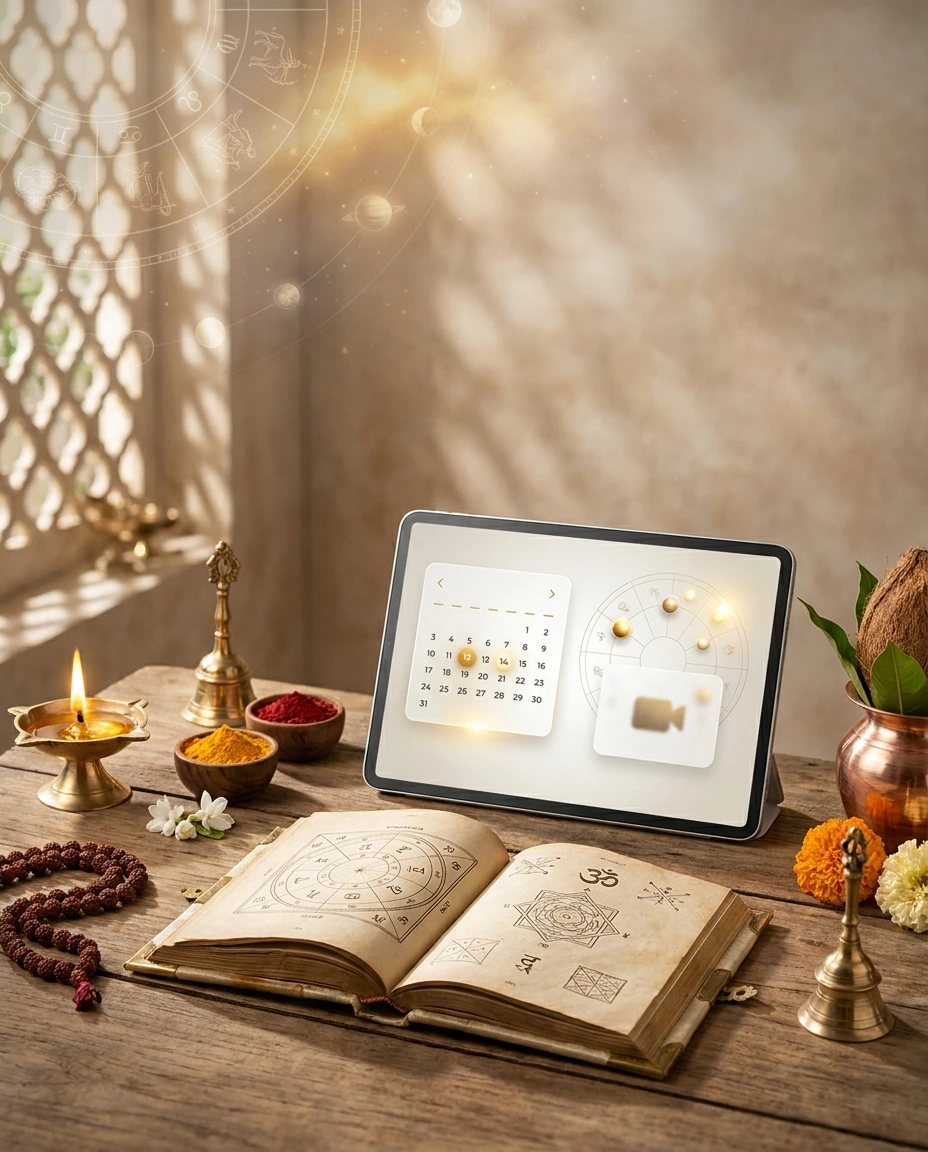
Every big step in life—whether it’s getting married, stepping into a new home, or starting something close to your heart—feels better when you know you’re beginning on the right foot.
In Vedic astrology, a muhurtha is simply the best window of time to start an important life event. Think of it like catching the right wave or planting seeds in good season: when the timing is natural and supportive, everything flows with much less effort.
In simple words, choosing a muhurat means picking a moment that carries peaceful, steady energy. It helps set a calm tone from day one, clear away unnecessary hurdles, and give your new journey the best possible start.
In simple terms:
Fixing a Muhurtham is simply finding the friendliest date and time for you, guided by the traditional Panchangam calendar and your personal birth chart.
Every good start begins with Panchanga Shuddhi—clearing and balancing the five fundamental limbs of time, alongside daily protective factors.
Beyond the calendar: Panchanga Shuddhi is the starting point. An experienced astrologer also aligns the rising sign (Lagna), personal chart compatibility (Tara Balam), and favorable planetary transits to protect your milestone.
Tithi
The lunar day phase—evaluated to ensure the natural cosmic rhythm supports growth and emotional clarity for your event.
Vara
The weekday and its planetary ruler—chosen to match the nature of what you are starting, from peaceful commitments to active ventures.
Nakshatra
The day’s dominant lunar constellation—checked for long-term stability and friendly resonance with your personal birth star.
Yoga
The combined relationship between the Sun and Moon—filtered to choose harmonious energies and sidestep friction.
Karana
The half-lunar interval—fine-tuning the exact window of action to ensure steady progress and smooth execution.
Daily Time Filters
Carefully filtering out disruptive, volatile windows like Rahu Kalam, Yamagandam, and Gulika Kalam.
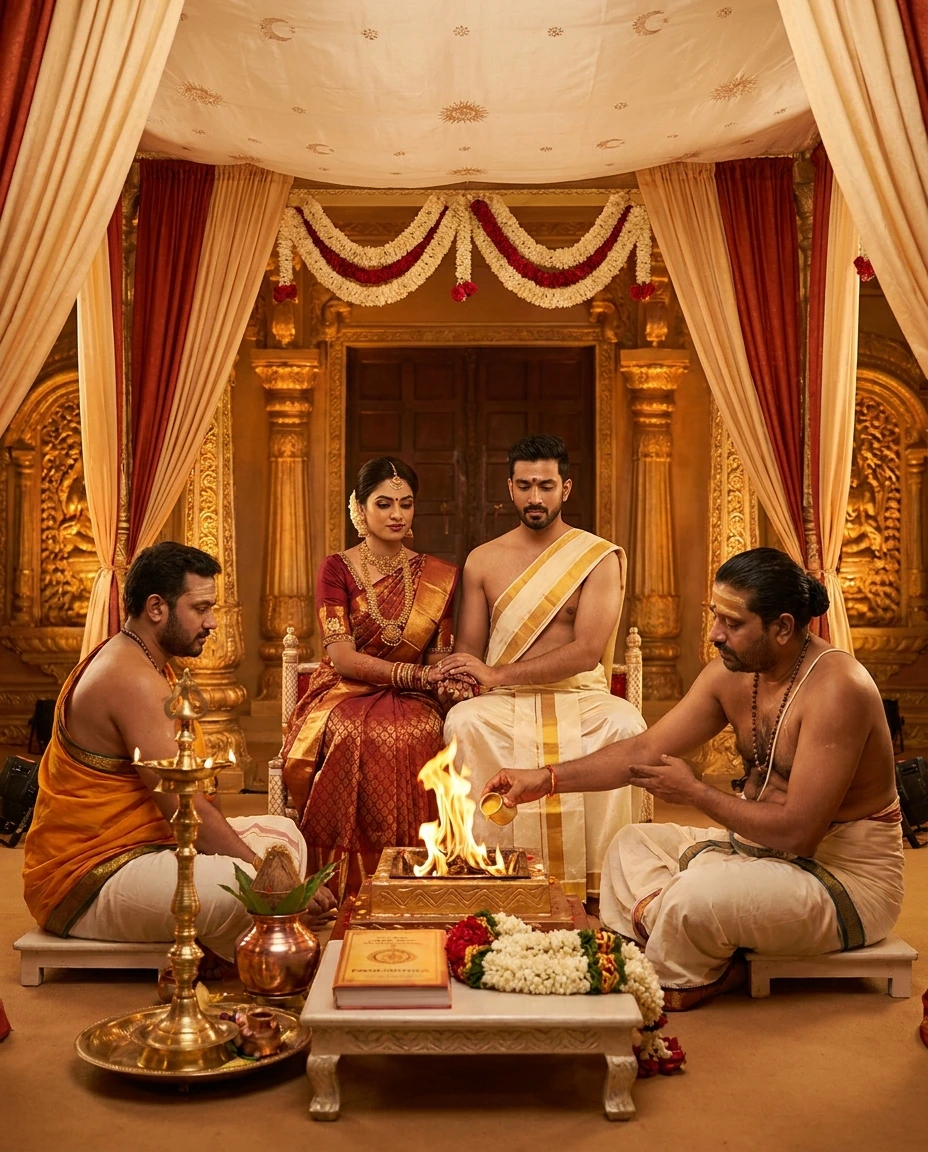
A wedding unites two journeys into one. In Vedic astrology, fixing a wedding muhurtham is an intentional process designed to shield the bond from friction and invite lifelong harmony, mutual respect, and stability.
Dual Chart Compatibility: Balancing the bride and groom’s birth stars to support emotional bonding and shared prosperity.
Planetary Strength (Guru & Surya Balam): Confirming strong placement of Jupiter and the Sun to support wisdom, health, and family lineage.
Purity of the Lagna: Selecting a peaceful rising sign at the exact moment of the Mangalya Dharanam ritual.
Filtering Inauspicious Windows: Ensuring the chosen date stays clear of planetary combustion periods (Moudhya) and eclipse shadows.
Because marriage brings two families together, comparing a few viable dates helps you find an auspicious moment that also works smoothly for your guests.
A wedding muhurtham is selected after examining the date,
time and relevant horoscope factors together.
01
Panchanga Shuddhi
The Tithi, Vara, Nakshatra, Yoga and Karana are examined
for the proposed ceremony.
02
Guru & Surya Balam
Traditional marriage muhurtham calculations may consider
the strength and transit position of Jupiter and the Sun.
03
Shukra & Guru Moudhya
Periods traditionally associated with the combustion of
Venus or Jupiter may be considered when selecting marriage dates.
04
Lagna Shuddhi
The selected Ascendant and its relevant houses and
planetary influences are examined for the ceremony.
05
Tara Balam
The relationship between the individual's birth Nakshatra
and the selected day's Nakshatra can be considered.
06
Final Time Selection
After unsuitable periods are filtered out, a suitable
ceremony window can be selected.
Vastu & Construction
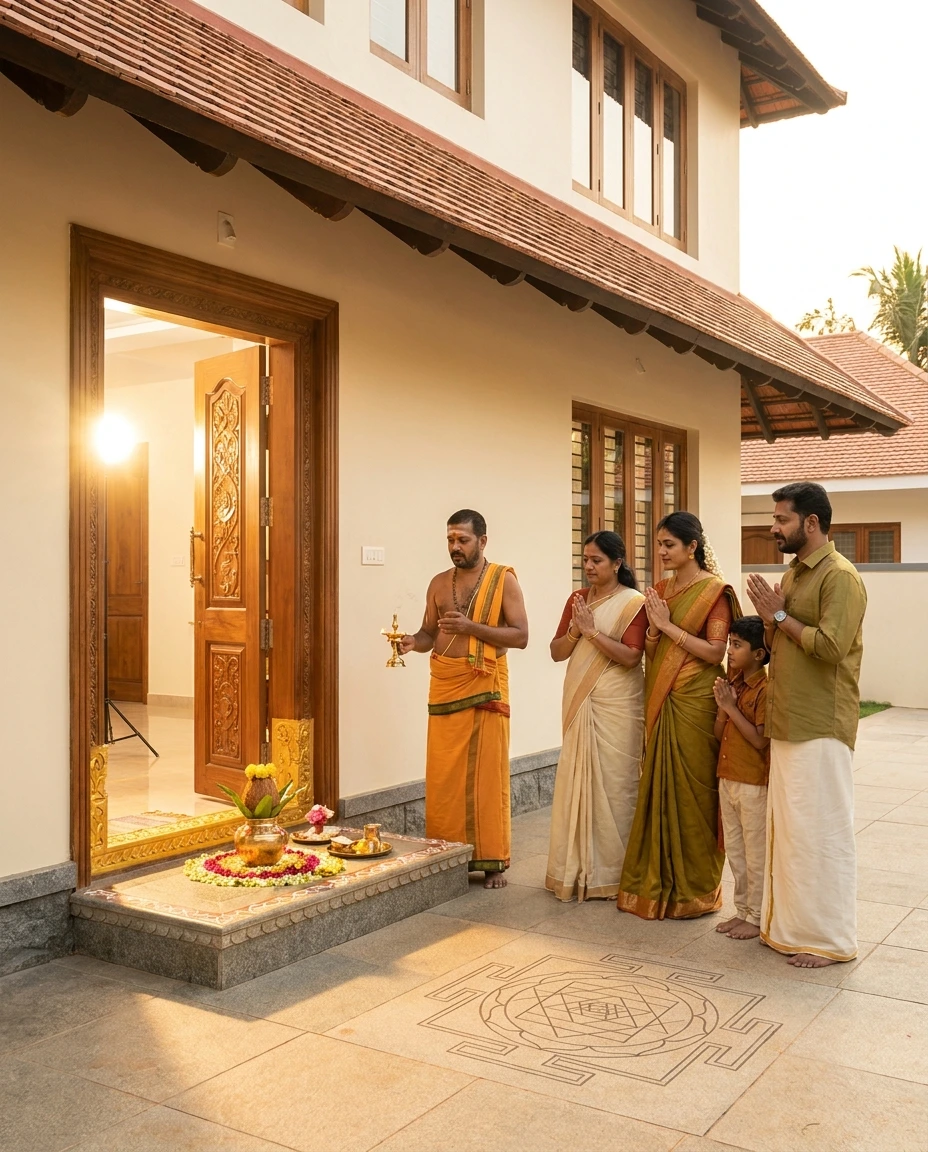
Muhurtham for Fixing the Main Door
Beyond Bhoomi Pooja, some traditional Vastu practices also
consider an appropriate time for fixing the main entrance,
sometimes referred to as the Simha Dwaram or
Vasakkal.
A muhurtham for fixing main door 2026 may consider:
A general Panchangam can show commonly favourable periods.
Personalized fixing can take additional individual and event-specific
factors into account.
01
Individual Factors
Your Janma Nakshatra, Rasi and other relevant horoscope
details can be considered where appropriate.
02
Event-Specific Timing
Marriage, housewarming, construction and rituals
can require different timing considerations.
03
Location & Time Zone
The location where the event takes place matters when
calculating the actual local time of the muhurtham.
A suitable muhurtham should be calculated for the actual
place and purpose of the ceremony.
Online Astrology Consultation
How to Get an Accurate Muhurtham Fixed Online
Traditional muhurtham calculations can involve Panchangam,
horoscope and location-specific considerations. Online
consultations allow families to discuss these details
without being physically present with the astrologer.
A standard calendar or app only checks whether a day is generally auspicious for the public. It cannot account for your personal birth chart. A personalized muhurtham ensures the planetary alignments harmonize directly with both partners' Janma Nakshatras, checks for individual Tara Balam and Chandra Balam, and selects an ascendant (Lagna) that strengthens the specific event.
Fixing a muhurtham is a multi-step filtering process. An astrologer first ensures Panchanga Shuddhi by verifying five core limbs: a supportive Tithi, Nakshatra, Vaara (day), Yoga, and Karana. From there, we evaluate the Lagna (ascendant) of the exact hour, ensuring strong benefic placement, clean 7th and 8th houses, and personalized planetary compatibility with both individuals.
Astrologers screen against several classical afflictions, most notably Karthari Dosha (benefic houses hemmed in by natural malefics), Shashtashtaga (unfavorable 6/8 planetary angles), solar ingress days (Sankranti), and periods under Rahu Kalam, Yamagandam, or Gulika Kalam. For weddings, keeping the 7th house completely unoccupied by malefic planets is paramount.
Tara Balam evaluates the strength of the day's transit star relative to your birth star (Janma Nakshatra) to rule out zones of obstacle or danger (Vipat, Pratyak, Naidhana). Chandra Balam tracks the Moon's transit position relative to your natal Moon sign. If the Moon transits your 6th, 8th, or 12th house on that day, it creates a weak transit that is typically avoided for life milestones.
A day lasts 24 hours, but a Lagna changes roughly every two hours. While the day sets the general cosmic background, the Lagna represents the actual birth chart of the event. Even if a day has minor calendar flaws, choosing an exceptionally strong Lagna with fortified benefics can neutralize many generic daily blemishes.
Yes. Running a Rahu or Saturn Dasha does not bar anyone from marriage. What matters is the functional role and dignity of those planets in your individual chart, alongside the Antardasha active at the time. A skilled astrologer will pick a muhurtham Lagna that pacifies the Dasha lord and fortifies longevity and marital harmony.
You are never locked into a single date. Auspicious windows occur across multiple weeks. If prime dates clash with hall availability, an astrologer evaluates secondary favorable dates, shifts the timing to an auspicious Abhijit Muhurta, or utilizes a strong planetary Hora that provides solid protection during practical time constraints.
These restrictions stem from traditional solar calendar rhythms and regional climate wisdom. In South India, months like Aadi (Dakshinayana transition) and Margazhi are traditionally reserved for spiritual discipline and temple festivities rather than marital alliances. Agni Nakshatram marks intense peak summer heat, historically deemed taxing for large ceremonies.
While major structural rites like Bhoomi Pooja are only for owned land, entering a rented home still sets the energetic foundation for your stay. Families typically observe a simple Griha Pravesh—often focused on milk-boiling (Paal Kaichuthal) and Ganapati Pooja—timed to an auspicious Lagna to invite stability and peace.
Absolutely. Muhurtham calculation relies on precise mathematical data—birth dates, exact times, places of birth, and the ceremony's geographic coordinates. Digital consultations allow astrologers to calculate charts with astronomical ephemeris software and walk you through suitable windows via structured reports or calls.
No muhurtham can erase or rewrite a natal horoscope. What an auspicious muhurtham does is provide the best possible cosmic "departure time" for the journey of marriage. It shields the ceremony, strengthens mutual understanding, and minimizes friction, but it works alongside—not instead of—sound chart matching and remedies.